A few years ago, I happened upon a little show on the BBC iPlayer when I was bored. That show was called “The Chaser’s War on Everything”. If you’ve never seen it, The Chaser’s War is a stunt and sketch comedy series by an Australian comedy toupee. They skewer the modern world – entertainment, politics and so on. It’s a great show and Australia’s National Broadcaster (The OTHER ABC) is rightly proud of The Chaser’s work. The BBC showed it here in the UK and I can only imagine they did so with envious eyes, because BBC Three’s latest comedy show “The Revolution Will Be Televised” is a fairly direct clone.
BBC Three, which bills itself as “Never Afraid to Try New Things” has a recent history of trotting out all-new comedy series. Some of these are frankly brilliant, like the puppet-based adult sitcom “Mongrels”. Unfortunately, they cancelled that show. Others among these BBC Three Comedy experiments are less funny. Like everything they have done involving Russell Kane – a man whose comedy I have yet to find a single person admitting to enjoying.
Unfortunately, “The Revolution Will Be Televised” appears to have come from the same BBC Three programmers who cancelled “Mongrels” and have been pushing Russell Kane harder than a Sixth Form Tutor pushes University applications and not from the people responsible for putting shows like “Mongrels”, “Bad Education” and “Wilfred” on BBC Three’s airtime. Because it’s painfully flawed.
PAINFULLY flawed.
Of course it’s entirely possible that all these shows were picked up by the same programmers. In which case I would definitely have to characterise their efforts as “hit or miss”. Speaking of which…
That’s basically the biggest problem with “The Revolution Will Be Televised”, at least as far as the first episode indicates. Too many of the stunts fall flat in their efforts to be funny. Actually, that’s not entirely it…
More accurately, almost all the stunts have some good ideas and funny bits in them (The exceptions from Episode 1 wold be the MI6 stunt – which was just utterly moronic from the moment it started to the moment it mercifully ended – and the Occupy Protests stunt – which took a good idea for a stunt and wasted it by having an unfunny halfwit try and do what “The Daily Show” correspondents have been doing successfully for years and failing miserably). The problem is…These guys just don’t seem to know when they’ve got the laugh.
Jon Stewart with some of The Daily Show’s Correspondents
Once you’ve got the laugh, you stop. And you move on. To keep things fresh. Here, our would-be revolutionaries continue labouring the point well past the time the shock value wears off. The Chaser never did that. If the laugh came earlier than they were expecting, they simply escalated. That kept things fresh and replaced the shock value with refuge in audacity.
The Chaser
What’s worse though, is that most of these bits were repeated. Oh yes, not content to outstay their welcome alone, several of the episode’s stunts were broken up into chunks. Meaning that we were treated to a re-tread of the same joke later in the episode – a joke which had already been overused before the re-tread even started. Frustrating to say the least.
There’s something funny to be done with the ideas behind “The Revolution Will Be Televised”, but I’m not entirely confident that Heydon Prowse and Jolyon Rubinstein are the right people to execute on it- at least, not on their own. I feel like with more than just the two creators putting stunts together and carrying them out, the’d be able to cover more ground. That’d really help a lot.
Still, maybe things will pick up with the later episodes. It happened for Ten O’Clock Live Season 2 after all.
It’s that time again! After giving my thoughts on Tuesday’s Semi-Final, it’s now time for me to feedback on Eurovision Song Contest 2012 Semi-Final 2, which took place last night. If you want to remind yourself of context and so on, check out the introduction to the Semi Final 1 Post. You might even want to check out those thoughts before looking at these if you haven’t already red the other post.
Now, before we get to the actual competitors’ entries, I’m gonna go ahead and say that last night’s show was much better than Tuesday’s. There were two reasons for this. First, but less importantly, the BBC’s production was much smoother yesterday. Tuesday it seems as if the talent and production team had turned up five minutes before air and had no idea what they were going to be doing more than five to ten minutes in advance. Last night flowed much more smoothly, it felt a lot more planned & considered.
They also made sure Sara Cox was rarely without Scott Mills to balance out her irritating quirks (Cox is much more agreeable playing off Scott Mills than she is trying to be funny on her own).
Secondly, and most importantly, Azerbaijan’s Semi-Final 2 played host to one of the coolest Eurovision interval acts I have ever seen – I’m almost disappointed they wasted it on the Semi, it easily would have been at home in the Final proper. They got the most recent five winners of the ESC onstage together to perform a medley, including the relevant winning five songs and then a fantastic group cover of Waterloo.
It was awesome. The winners put in standout performances, it sounded great and as a Eurovision nerd it was simply cool to see. Plus, it means Lena was at the ESC for the third successive year.
And it’s no secret I adore Lena, having voted for her on both occasions of her entering the Contest. She’s lovely, and I was pleasantly surprised and delighted to find out she was back again.
Anyway, with that out of the way, on to the finalists!
Serbia
Serbia kicked things off with a rather mournful ballad – which frankly set the tone for what wound up being a fairly ballad-heavy semi. Serbia have won with a ballad before, but I’m not really sure it’s gonna work twice. The entry’s not awful, but it didn’t exactly ignite my passions. It did, notably, innovate. Yes, rather than falling into the “pretty lady with a violin cliché…
Yep, it happens that quickly. Macedonia went second, and they too put on a mournful ballad (Albeit one which was a little bit more rousing towards the end) with a pair of pretty ladies paling violins. The similarity of the two acts first onstage is frankly hilarious. Luckily they’ve been separated a bit in the Final.
Not much to say about these two if I’m honest. They’re not really to my taste, I’ve only occasionally liked Eurovision ballads (Molitva deserved its win against the finalists that year in my opinion, though Salvem El Móm was the best song in the Contest overall). Still, there are worse songs than these two in the contest. In fact there’s worse songs in the final.
It’s Albania. I’m talking about Albania. That song is baaaaad.
Malta
I was slightly concerned this wouldn’t get through. It’s very good; and it has a suitably epic feel (Definitely plays well as a stadium performance, put it that way); but despite it’s catchy, poppy style it also flirts heavily with the rock music aesthetic. And as we know, rock songs have a history of being streets ahead of other songs in the contest and being left in the Semis anyway (Like Salvem El Móm).
Fortunately for Malta, it appears the maltese entry’s pop music stylings saved it from the rock music curse. It may have helped that there was another entry with more overtly rocky stylings to absorb the curse…More on that later.
Ukraine
Ukraine have been known to send some bizarre acts (Dancing Lasha Tumba? That was the Ukraine entry that year. Yeah), and it seems to work for them. Be My Guest continues that proud tradition:
And indeed, this is a particularly strong example. The song is actually pretty damn good, which always helps make a novelty act worth our attention, the singer is fairly easy on the eyes and the entry as a whole is very Eurovision. Definitely earning a spot in the final, I noted at the time that there was no way this song was failing to make the cut.
Behold, ladies and gentlemen, the out and out favourite to win:
Euphoria, Sweden’s latest effort, leads the bookies’ odds and the buzz in the hardcore Eurovision crowd is that this is in with a really good chance of stopping the Russian Grannies (The number 2 seed, buoyed by the novelty factor).
And it’s…Actually not bad. It’s not my favourite song in the contest, but I do like it, despite initially not taking to it. I kind of felt like the verses were a bit incomprehensible last night though. It’s possible, however, that this was a technical thing and not related to the song, so it might sound better on Saturday. At any rate, not my pick, but I’d not be upset at it winning.
Unless it narrowly beats Denmark. Then Sweden can go to hell.
Turkey
Turkey sent a novelty act. Hahahaha, we get it, they made their weird costumes link together in the form of a boat around him. Isn’t that marvellous?
Not especially, no. Annoyingly, the song is actually alright. The problem, as I see it, is that the singer is not…What’s that word…Good? He’s maybe passable. But not good. The song has a relatively catchy hook, but I constantly felt the lyrics and the music were on keys which were not only quite far apart, but also so far apart it seemed unlikely the two had ever met.
Not great, might do well anyway though. Not especially bad either at least.
Estonia
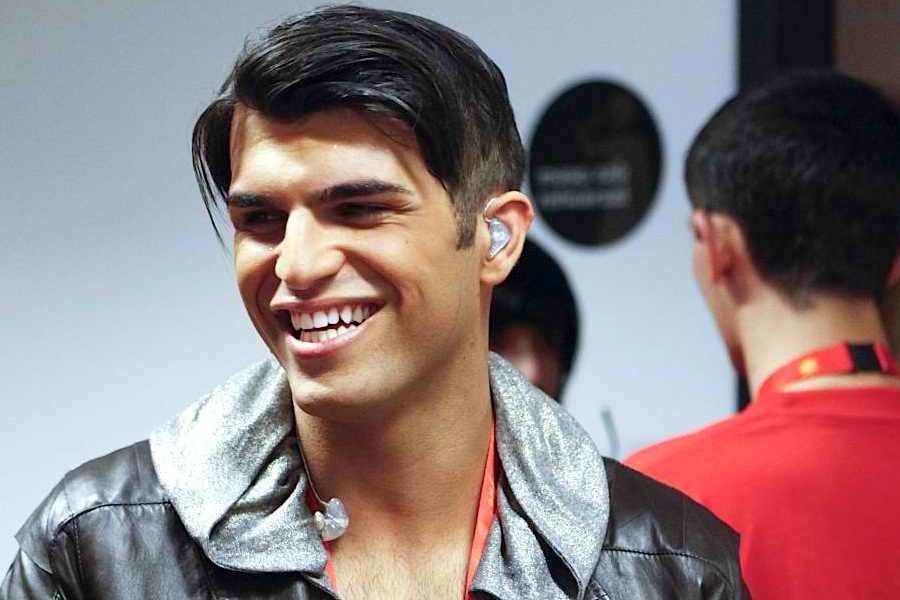
This is an entry which elicits a “meh” from me. It’s in no way bad, but it’s not really my cup of tea (it’s another soppy ballad). THere was some amusement to be had with its singer though, who is Estonia’s answer to Zac Efron (He played Troy in Estonian High School Musical) and perennial nobody Chris O’Donnell.
It could also be that this guy is the magic offspring of Kutcher and Taylor Lautner.
Joking aside, Norway put in a solid effort. Nothing much to complain about here. Competent entry, decent enough song, no surprise it made the final. It’ll probably do quite well. I didn’t like it early on in the performance and felt like it might go out, but by the end it had flipped me and I was approving, though slightly concerned about what the judges would do with it. Concerns were ill-founded, since it made it in.
Bosnia And Herzegovina
Bosnia & Herzegovina sent Romana, one time Lord President of the Time Lords (Snark snark her costume is preposterous oh that Bosnia and Herzegovina etc. etc.) to perform an example of my least favourite Eurovision entry type, a weeper – a particularly soppy, miserable and downbeat ballad.
Not a fan, but apparently Europe is because it got in along with…
Lithuania
Who also sent a weeper – though at least theirs became a bit more rousing toward the middle and back half. Still not one of my favourites, and I certainly would;t have been sorry to see it go out. It capped off what turned out to be a very ballad-heavy Semi Final, and I have to say I strongly disagree with the sentiment of some other Eurovision geeks (At least ahead of Semi Final 2) that Semi Final 1 was the weaker Semi. Only a few good songs if you ask me – and precious few of those made it from Semi Final 2 to Saturday’s Final (More on that below).
Lithuania did provide me some amusement though, as 24 year old Donny Montell (4 years my senior) looks about half that age.
See, I’m not sure if Joan Franka realised 120 Million+ People watch this thing. Because it certainly seemed as if she thought it was a little thing down the pub. Her jaunty little love-themed ditty wasn’t awful, but it was by no means good. It sounded weird and she looked high most of the time she was onscreen (She even seemed under the influence in the Green Room).
Still, the netherlands did decide to keep up the theme of innovation with violins from the two acts before them, by changing things up in a crazy new way:
Note for the record though that a male violinist did win for Norway in 2009. He was also the lyricist though.
Belarus
Belarus overturned the result of the national tele-vote to pick their entry because their country’s leadership agreed with the population’s sentiment that the vote had been rigged to prevent this entry from winning.
Well, you know what Belarus? You should have let BTRC rig the result. Lightspeed’s effort was incredibly mediocre. Another bloody Eurovision Song about succeeding against long odds, with clichéd boasts of presumptive triumph thrown in? Jeez, guys, 2007 called, they want their semi-finalist dropouts back.
No surprises this went to, and no huge loss to the Contest.
Portugal
The first big scalp, at least if the hype was to be believed. If you ask me though, a lone woman in a showy dress in front of a crowd of barely moving backup singers (take a shot) singing a ballad? Yeah, like we needed another one of those. Portugal sent a particularly uninspiring effort at a style already being overused, so they were always going out.
Bulgaria
Bulgaria’s entry had a lot of hype behind it because it had one of the least worthless gimmicks of all the gimmicks entered this year (And there’s quite a few of them, as per usual). You should check it out, because it’s actually not bad – in fact I had it pegged as probably getting through, though I did imagine it would endure anonymity in the final. I guess Europe had other ideas.
Slovenia
For my money, the biggest scalp of the night, was this rather enchanting entry from Slovenia failing to make it into the final.I really liked it, and it seemed like a lock to me:
But it seems Europe didn’t want that much variety in the finalists tonight (We’ll get to that) and so they decided the only song tonight which successfully took the “get a lady to sing a song” idea in a direction other than “make it a ballad because real art is sad!” should be shown the door. Kind of a big loss. This was a good one. One of my top five for sure.
Yes, it starts off as kind of a ballad, but unlike the others it quickly builds to something anthemic. The others stick pretty stubbornly to downbeat balladic themes. This one reminds me of Molitva, in that it becomes very powerful and catchy as it builds.
Also, she’s quite pretty.
Croatia
Croatia’s entry opted for an…Ahem…Innovative approach to preparing for the Contest.
Yeah…So that was weird. And not worth it because it didn’t go through. No huge loss, it merely joined the throngs of songs last night which were mournful dreary ballads sung by women. In fact, this one really took the cake:
And yes, the Eurovision key Change did lead to it being a bit more upbeat, but enough of it was dreary and miserable that it failed to excite me the way Slovenia did.
Georgia
Baffling. Just baffling.
Not awful.
Just…Baffling.
Not a huge loss, though not abysmal.
Mostly? Baffling.
Slovakia
Simultaneously the biggest scalp of the evening (Semi Final 2’s best song – hands down) and the one I was least surprised was forced out. Slovakia, failing completely to heed my repeated warnings about rock songs frequently being among the best songs in the Contest and yet still going out in the Semi because apparently Europe hates rock music now, entered “Don’t CLose Your Eyes” and…Just listen to it:
How can you not want to rock out to that!? It’s fantastic. This is exactly the kind of song which would be played all over University Campuses.
I voted for it, despite knowing full well it was probably a waste of effort. I had to try. Andorra going out still leaves a bitter taste in my mouth (As you may have noticed). Alas, the curse struck once again, and so another of the top five songs in the entire contest has gone out at the first hurdle.
This was the dog with the best chance of unseating Denmark was my personal voice for winner. But Europe hates rock music, and so Slovakia’s chances are down the drain.
Ah, the Eurovision Song Contest. Music as sport, with hilarious campiness and snark added for that little extra spice. As you might know, I ADORE it. I watch it every year and blow up Twitter with my ongoing commentary on everything that happens. And now, I’m blogging about it too (Ahead of having a mini Eurovision Party on Saturday for the first time!)
Here then I will be writing up my thoughts on Semi Final 1. I’ll do the same on Friday for Semi Final 2, and Sunday for the Final. Naturally, during the shows, my usual Twitter service will be in full effect. Saturday’s should be fun, as I’m going to be drinking Beer and playing a Eurovision Drinking Game and there’s nothing funnier than drunken live tweets. Now, for context, I take a semi serious approach to ESC. I treat it as a serious competition of musical performance but I’m entirely okay with it being light entertainment. And the fact is, if you take the show slightly seriously, it makes the campy nonsense even funnier to snark about.
With that in mind, I tend to favour serious entries, by which I mean heartfelt genuine efforts to produce a genuinely good song and performance, over the deliberately absurd gimmick entries – though if the song is good, I can appreciate the gimmick. I do, however, have a preference for more upbeat tracks. That said, I’ll support something more akin to a ballad provided it’s catchy enough or what have you.
With that out of the way then, here’s my thoughts on, first, the ten lucky entrants who will join the Big Five & Our Hosts (Azerbaijan) on Saturday.
Iceland
A heartfelt ballad duet song by a pretty girl and a handsome guy. Okay, first of all, take a shot. Take another because the pretty lady has a violin. Second…Meh? There’s almost always a song like this, and I can’t for the life of me recall it winning…Except, last year. Yes, that’s right, Iceland have turfed up as both this year’s cliche storm entry and the entry flagrantly ripping off last year’s winner (Another thing which also always happens – oh you better believe you should take a shot). It’s inoffensive enough like, so it was always getting through, but I predict (and hope for) relative anonymity on Saturday.
Greece
What’s that? Greece have sent a pretty girl with a sexually suggestive song who dances around provocatively giving us a good view of her legs and the occasional panty shot? Take another shot, and I hope you weren’t planning on driving tonight because you’re already wasted. Greece have pulled this exact stunt several times, as have other countries with admittedly less frequency than our cash-strapped Olympic inventing friends. Their best effort in this regard was 2008’s Kalomira, who at least seemed like a lovely girl on top of being pretty (it was also probably the best song they’ve sent with a pretty girl dancing suggestively, which helped). I doubt Greece are going to score big with Eleftheria and her “Aphrodisiac” (Subtelty has gone out the window incidentally), still the girl’s nice to look at.
Albania
Albania’s entry sucks. It just flat out sucks. This is an awful “song”, in a horrible style sung by a woman with what appears to be the weirdest hairdo in ESC history – think about that for a moment. How hard would it be to be that weird? She managed it. It’s mournful, a-melodic screeching and I’m frankly disgusted it got through. I have to imagine the judges are responsible for that (out of some pretentious belief that it’s artsy) because if Europe voted in droves for this dreck, I despair for humanity in general.
Romania
Another meh here. This is a song which left very little impression on me. I predicted at the time it would get through, as it had a distinctly inoffensive blandness, but I’d be amazed if it breaks the top ten in the final. Not much to say really. It’s okay, I guess.
Cyprus
Here we have Cyprus copying Greece’s signature play, which if you think about it is all sorts of hilarious given the relationship between the two nations. Yes it’s a pretty girl dancing about and singing a relatively catchy pop song. But, interestingly enough, it seems Cyprus may just have beat Greece at the latter’s own game. “La La Love” is undeniably a better song than Greece’s entry. And Ivi Adamou, whilst perhaps not quite as overtly sexy as Eleftheria, is probably prettier than her Greek rival – and pretty girls tend to be more likely to succeed in ESC than simply sexy ones.
Denmark
Speaking of pretty girls doing well, Soluna Samay is very pretty. Although her fashion sense is a bit suspect, as noted in response to me by @SLomasSCFC1883:
Anyway, Soluna has entered a catchy acoustic pop song called “Should Have Known Better”. This song is fantastic. It’s a wonderfully pleasant listen. It’s technically a bit sorrowful if you listen to the lyrics, but it’s composed in a delightfully hopeful manner. This, for me, is the standout song of the Semi, and it’s my favourite so far (I’ve heard all the songs barring those in Semi Final 2 and the UK’s entry, which I usually wait until the final to hear unless there’s a public vote to pick it). I love this song, and Soluna is well on her way to getting my vote at this rate.
Russia
I’m in two minds about the infamous “Russian Grannies” entry. On the one hand, it is delightfully silly and genuinely endearing. Plus, it is appealingly catchy. After all, it’s a cheesy pop song. They tend to be catchy. On the other hand, it’s the Russian entry. This isn’t going to make sense to you if you’re not a Eurovision nut like myself, but we really don’t need or want to be going back to Russia, and the bitter taste of their last victory is still in my mouth. Unfortunately, this could be a lock. It’ll play well with the casual voters Europe-wide. The judges will take a dim view, but that could well not be nearly enough to keep this from winning. Apart from anything else, I’d like to keep it from winning precisely because it’s goofy. As noted above, I prefer genuinely good songs to win. Like “Should Have Known Better”.
Seriously, Soluna is this year’s Lena, I swear.
Hungary
Hungary’s was another entry which had “heading on to certain obscurity in the final” written all over it, with the the added bonus of being another example of those entries which seem to make an appearance every year (Yay for generic entries I guess?):
So, yeah. Not a lot to be said. It wasn’t awful, but I doubt it’s contesting the win.
Moldova
I’m a little disappointed this got through. I mean it’s not awful. And there were worse songs which were deservedly left behind. But I could have done without it (Though, given the choice, I’d pick it over Albania’s shameful waste of a slot any day). It’s a predictably absurd entry from the Moldovans, and I’m starting to wonder if they’re not a bit unhinged. From the weird costumes to the slightly bizarre song itself, it’s just a smidge too goofy for my tastes. And the fact it’s not even full on goofy makes it worse. It’s almost a normal entry. But with absurdity smeared all over it for no apparent reason. I’m not a fan, but it could possibly do well.
Ireland
Yeah, it’s Jedward. Back for another go. Funnily enough I actually like Waterline more than last year’s “Lipstick”. It’s a more sincere effort at a song. And the theatrics onstage with the fountain were pretty great actually, made a nice change to the usual fireworks and props stuff. Biggest mistake? Jedward’s needless shiny spacesuit outfits. Completely out of place with the song and just generally stupid. I know they’re supposed to have this quirky stage persona, but I just think it doesn’t fit this song and it’s possibly hurt their chances.
Incidentally, I’m not sure why, but the press (Or at least, the BBC) seemed baffled by the word “waterline” and kept asking “what is a water line?” of Jedward. The boys were equally baffled by the question. But I would suggest this was not, as it may have seemed, because they didn’t now, but because they weren’t prepared to be asked such a moronic question. It’s the surface of a given body of water. The metaphor, equally, is pretty self-explanatory. I really didn’t understand where the confusion arose from. But there you are.
Anyway, those are our ten qualifiers. Let’s take a look at the eight acts which have crashed out of the contest for the year now.
Montenegro
Montenegro it seems did not make a sincere effort, with their entry coyly describing his attendance at the contest as a “mistake”.
I’d have to assume this is because they don’t want to pay to host the contest next year – fair enough, other nations have done the same thing. I do wish they had chosen to simply enter something which would just “never win” rather than this abomination of a time waster. I think it was supposed to be funny. But it wasn’t. It was just genuinely bad. Which is not a substitute for funny.
Yes Latvia’s bizarrely staged “Beautiful Song” turned heads for the oddly broadway-esque style of its opening moments and the “vaguely attractive in an ugly sort of way” looks of is performers. Unfortunately, the heads turned were treated to an ironically bland and forgettably mediocre ode to a beloved and memorable song (Presumably it was supposed to be shaped like itself. It was not.)
Switzerland
Switzerland made two mistakes. First (technically second, but I’m addressing it first) of all, their lead singer was squinting distractingly in one eye as the song began. The effect was incredibly bizarre and unsettling. Second (really first), they entered a rock song.
And so it proved, as Switzerland became another example of a rock song failing to make it out of the Semis. Personally, I think it’s a shame, I’d like to see more rock songs in the final, even if just for the sake of variety. But alas, the trend continues. Still, at least it wasn’t as disappointing as 2007, when the best song in the entire contest (Andorra’s “Salvem El Móm”) didn’t make it out of the Semis having fallen victim to the rock song curse (Amusingly though, the contest was held in Finland that year because the previous year Finland broke the rock song curse by combining it with a gimmick – the oldest Eurovision trick in the book – in the form of Lordi, the monster make up performers).
Belgium
Belgium had a sweet entry, with 17-year-old Iris rivalling Soluna for prettiest girl performing. The entry was perhaps held back a bit though by the fact that it was a bit boring. The song started off seeming as if it was building to something which never really came. It could have done with an uplifting chorus, final verse or even middle eight to lift things. Instead it came across as a wee bit mournful. This and Switzerland’s efforts though, by far the least deserving of being ejected. I myself would have swapped this in for Albania and Switzerland for Moldova. But that’s the way the cookie crumbles. I originally thought the judges might save it, but it would seem not.
Finland
Finland have fallen a long way from winning six years ago. This year’s entry was a blandly uninteresting cliche storm, which I’ll let my Tweets summarise:
I guess they were trying to do an Iceland, but their effort fell flat. It was never getting through.
Israel
Hooray! Israel knocked out in the Semis! I really am sick of Israel turfing up to these contests and trying to make a mockery of proceedings. This year’s acid trip of a clanger was no exception, and I was not in the least bit sorry to see it go. It ranks in my bottom four alongside alongside Albania and our next two evictees.
San Marino
San Marino tried to enter a song called “Facebook (Uh Oh)” but were politely reminded commercial messages are banned. They renamed it “The Social Network Song” and inflicted it on us anyway. It stank. It’s bad. It’s terrible. It’s musically pathetic, lyrically awful and it falls into the “You’ve Got Mail” trap hard. Some of its apologists are pointing out that it’s meant to be satire. And, okay, yeah, it’s satire. Fine. That doesn’t excuse the fact it’s awful. It’s horrible to listen to. You wanna write a satirical song, go right on ahead, but make it a good song. San Marino’s crime is identical to that of…Ugh…Dustin the fucking Turkey.
Thankfully, like Dustin, this atrocious act of parody was shown the door in the Semis.
Austria
Austria just weren’t trying. From their TV-unfriendly artist name (Trackshittaz is clearly a corruption of Track Shitters, whether you admit it or not, BBC) to the pole dancing, to the awful lyrics to the douchebaggish nature of the assholes performing the song, Austria apparently sought to make a mockery of the contest and were promptly shown the door. Eurovision may be campy and ridiculous, but you will never get far trying to take the piss out of the Contest like this. Didn’t work for Dustin, didn’t work for those idiots who ‘sang’ “We Are the Winners (Of Eurovision)” and it didn’t work for this pair of assholes.
That then is Semi Final 1. I’ll be back Friday with my detailed thoughts on Semi Final 2 (And you can see my Tweets live during the show @TVPaulD). In the meantime, I leave you with my thoughts on the Automatic Qualifiers:
France: Good
Germany: Good
Spain: Okay
Italy: Very Good
United Kingdom: SIGH, I really wanted us to send something with a chance of winning this year, but we did not
Rupert Murdoch always saw himself as a revolutionary. He blustered onto the scene in the United Kingdom with a singular aim: to take on the entrenched elite – the highly conservative establishment and the liberal elites who went some of the way to keeping the establishment in check – and deprive them of their power. His attack was ruthless, long and, for a time, successful.
But as with all things under his domain, Murdoch singularly failed to see the world change around him when seeing that change wouldn’t suit his vision of himself, and the world. He was all too happy to enjoy the perks of the power he wound up wielding over the UK’s political class – the elite he came to conquer.
But what he failed to recognise was that they weren’t the establishment if they were singing to his tune. He was the establishment. And what goes around comes around.
There comes a time in the reign of any despot when he creates his own worst enemy, and even hands that enemy the weapon needed to beat him. It’s an unavoidable fact. Power corrupts, absolute power corrupts absolutely. And when you’re absolutely corrupted by absolute power, arrogance is unavoidable. And arrogance seeped out of every pore of the News Corp operation. From Rupert’s stubborn insistence that Paywalls online will work (When they patently do not – his own efforts at The Times and sunday Times are laughingstock loss-makers) to James Murdoch, the heir apparent, having the audacity to lecture the media on how the BBC is corrupt, News Corp has conducted itself with unmissable swagger over the past few years in particular.
The news colossus had thought itself untouchable because, rightly or wrongly, it was perceived as the opinion maker. Sometimes the appearance of the ability to sway opinion is as powerful as that actual ability. It’s like when someone says “I’m not saying so and so is a murderer, I’m just saying he hasn’t said he’s not”. The status as the opinion maker was enough to allow them to frame the public narrative their way.
This arrogance spread like a cancer. It started at the top, with Murdoch’s diabolical grip on the corridors of power in Whitehall, and spread all the way down. Until finally, it infected some of the journalists, who saw their leaders picking and choosing whose political careers flourished and therefore assumed their publications were untouchable – Murdoch always got his way. And repercussions were dealt out to those who wronged his people.
And that’s when News International signed its own death warrant. And probably that of (At least part of) its global parent, News Corp.
Which brings us to how the deed was done. It was all deliciously simple. People working for News International – under the watch of James Murdoch, Andy Coulson and Rebekah Brooks – used illegal means to get their stories. And they did it a lot. And then they made the ultimate mistake: they let arrogance erode common sense and put themselves on the wrong side of certain public outrage.
When it was just celebrities and politicians believed to be victims of the widespread use of illegal investigative tactics, the sad fact is the vast majority of the public couldn’t bring themselves to care. This is pretty understandable. News International has orchestrated a culture of austerity, which has the masses more concerned with their own lives than the whinging of their oppressors (the politicians) and the better off (celebrities).
When you think about it, that was almost the perfect crime. Murdoch got his neo-conservative austerity programmes implemented and was able to use the atmosphere they created to smokescreen the dirty laundry used to get there. But then there’s that arrogance thing. The journalists responsible were blinded by their perceived invincibility.
They did the same thing to the public. Worse, to murder victims and grieving families. They crossed the moral event horizon.
And even more stupidly, they didn’t do a terrific job covering their tracks. Imagine that: journalists dedicated to finding scandalous scoops didn’t properly cover the tracks of their illegal dealings. What arrogance! Did they think that aside from being invulnerable to government and judicial intervention, the rest of the Fourth Estate was beholden to Murdoch just like the corridors of power? Or did they simply forget their power was not the result of superiority over their colleagues?
Whatever the manner of their hubris, they were undone by journalists doing real journalism.
The Guardian blew the doors off the whole thing over the course of a few years (They wanted to move faster, but judicial processes slowed things down). And once they blew the lid, everyone else seized the opening.
And really, it’s also amazing that News Corp didn’t see that coming too. The sheer arrogance of the operation is frankly incomprehensible. They were either so corrupt they were basically blind or else the outfit was run by a bunch of idiots. More likely, both.
For the truth is, News International and its parent have not done a great job making friends. All their “friends” were the politicians. And even they were never really friends. More brown nosers. Perhaps News Corp’s biggest error of judgment was in making rivals like the BBC, Trinity Mirror, Telegraph Media, Guardian Media and more not simply dislike them, but despise them.
Indeed, the enemies of News International in many ways needed to Kill the King to ensure their own survival. News International was the biggest game in town, and if they got a hold of the rest of BSkyB whilst managing to force the BBC – the only legitimate competitor to News International in terms of size – to cutback, scale down…Well the future was bleak for everybody else. Trinity Mirror, the sole remaining truly Left-Wing voice as it was would have been an especially big concern.
After all, what if The Sun crushed The Mirror, and then there was an election where the Indy and the Guardian endorsed the shamed Lib Dems again? All the papers in the UK endorsing the right wing and their lap dogs? That’s a chilling thought.
Meanwhile, what response could Virgin Media have had to the sudden massive escalation in size and power for its entrenched, larger rival – BSkyB? They already have to be in an uneasy partnership with them because of BSkyB’s borderline anti-competitive stranglehold on content. A combined News International-Sky could have snuffed out Virgin Media in a heartbeat. And all this whilst the BBC was thrown to the wolves by the News International attack dogs – the Conservative-led Coalition of the Losers.
So every player in the game had reason to let loose the dogs of war at the first sign of weakness in the King’s Castle. Worse still for News International, they had made an enemy of an old ally: they duplicitously went back to supporting the Tories after Gordon Brown’s (Initially hugely popular) Labour Party made overtures to going its own way on the back of Brown’s initial success. Call a snap election, win, and then be able to lead without Murdoch’s interference. That was the plan.
George Osborne, thinking himself clever, encouraged the ailing new leader of the washed up Tories to take the opportunity to become the new News International golden boy. Cameron went ahead with it. He hired Coulson, came to think of him and Rebekah Brooks as friends, followed their advice, did as Murdoch instructed. But more on the Tories later.
With the News International attack dogs forcing Labour out of power, the new boy came on scene. Ed Miliband. A politician in a mould so fresh the press kept trying to brush him aside rather than bother trying to comprehend it. The press had gotten lazy. They wanted politicians to be artificial people – puppets controlled by the Andy Coulsons of the world lurching from crisis to crisis with spin and PR. Ed Miliband is a straight-shooter. He talks like a human being. He was one of so-called “saints” of the expenses scandal. Murdoch, the epitome of press arrogance, dismissed Miliband because he didn’t understand him. The News Corp top brass didn’t consider this man a threat.
Oh how very, very wrong.
Miliband was the worst possible man for Cameron to face across the Dispatch Box when News Corp blew up in his face. Ed was on the right side of public outrage. Ed was no News International apologist. He wasn’t paying that game. He didn’t need to hop on the bandwagon, because in the political sphere he was the man driving it. Sincerely. And he was surely in no mood to be cautious. News International deposed his Party and assaulted his leadership.
Fitting then that is Ed Miliband who will probably Kill the King this coming Wednesday, by showing the leadership the Prime Minister lacks and leading the House of Parliament into a vote to block the BSkyB takeover bid which has so infatuated the Murdochs.
Welcome to the rise and rise of The Rt Hon. Ed Miliband, MP – The Leader of Her Majesty’s Most Loyal Opposition and likely The United Kingdom of Great Britain and Northern Ireland’s Seventy-Sixth Prime Minister.
But let’s get back to the Tories, they who were the last ones tied to the News International Pole when the music stopped (And, really, the ones who have mostly been in that position – Murdoch is a dreadful right-wing dinosaur and his family are much the same. That’s part of why they hate Ed Miliband, he comes from the core Centre-Left bedrock of Labour, where the Labour activists mostly lie). You’re probably wondering why I’m now so certain Ed Miliband will ascend to the Premiership when last week it looked like a tough ask (At least according to some analyses).
The Conservative-led Coalition of the Losers is held together by duct tape and the fact Nick Clegg is spineless. Had he not made the Coalition pact, Clegg would have been politically finished. Most Party Leaders would resign for doing far better than Clegg did. Gordon Brown did, for example. Many of us gave the Coalition two years at most before collapsing when it was formed. It turned out, Clegg was even more toothless and spineless than we thought. So we revised our assessments: it was going to run to term. Meanwhile, the presumed dissenting voices in the Lib Dems failed to step up to the plate. Rather than voting “no,” they would abstain like cowards.
So the Coalition, with its politically gerrymandered foundations and supports, looked set to rock on. After all, it was politically impossible for the Lib Dems to leave the Tories, they had all the toxicity. The Tories had somehow escaped. The Lib Dems were finished if they rebelled and the Tories would call a snap election they’d likely win.
But now, the Conservative Party’s leader, the Prime Minister David Cameron, has allowed himself to be seen to be on the wrong side of public outrage, whilst the Honourable Gentleman opposite him was The Public’s Voice in Tough Times. Cameron has had to back down, capitulate to Miliband’s demands. And still he has failed to move from the wrong side of public outrage by failing to apologise for hiring Coulson, by failing to call for Rebekah Brooks to be immediately fired.
And we now know there are more awful things about News International’s actions set to come out. So how can Cameron afford to be seen to be standing by any of the Chipping Norton set? He can’t, not really. The time then is ripe for Clegg to recognise his folly last year and bite the hand which has had him by the collar.
The Lib Dems can whack the Tories mercilessly on this, leap to Labour’s side, the side of public outrage, condemn their partner’s actions. And all the toxicity is flung onto the Tories in one fell swoop. Memories are short. Sure, Clegg will probably still lose his seat if he stands at the next General Election, but if he grows some balls and punishes the Tories for the public, some of his failings will be forgiven and he can be safely deputised to Europe by the inevitable Labour Government.
Have the Lib Dems set a date? No. Ed Miliband has though. This coming Wednesday. This coming Wednesday, the Coalition Government will be rocked by the fact that Ed Miliband commands a Majority in the Commons, however briefly. But once the Lib Dems and the factions within the Tory Party who want Cameron out have rebelled en masse once, what’s the point in stopping? Especially if the situation with News International and Cameron worsens. How long can Cameron reasonably expect to command a Majority?
I give it till no later than the end of October at this rate. Something unforeseen may occur to allow them to cling on, or the Lib Dems might be cowards after all. But barring that, the Government will likely collapse once Coulson et. al. are hauled back into the Old Bill. I could see the Lib Dems publicly trumpeting their future independence at their conference, Miliband preparing his Party to return to power at theirs, and Cameron resigning at theirs. It’s so beautiful in my mind.
Of course, it’s just the dream right now. But this is the moment in time we’re at. Revolution. It’s exhilarating, especially for those of us on the left, the progressives. We live for this. And it’s all the sweeter to turn the cannons on Murdoch, a man who once claimed the mantle of revolutionary, only to out-establishment the establishment.
The trouble, as I see it, is that whilst the downfalls of News International and their attempts to ensnare BSkyB are both inevitable (More on that in Part 2), the downfall of the Tories rests with the Lib Dems and Nick Clegg, a man of no political courage or power at present.
Still, the prospect of News Corp losing its 39% of BSkyB (Never mind failing to get the rest) is plenty exciting. We stand at a fork in the road. Ahead lies a bold new future of media plurality here in the UK. That’s down both paths. But down one, the age of austerity continues.
On the other road, the age of austerity withers and dies. Labour rebuilds this country and we all get back on with fulfilling the British Promise.
Remember this moment in time when we eventually do go to the polls, whenever it may be. 2011, 2012, 2014, whenever. It was Ed Miliband at the forefront of the Revolution. Ed Miliband leading for the people.
Turn Left, Go Forth: Vote Labour. A Future Fair for All, Free from News International’s Influence.
Season’s Greetings Friends, Family & assorted hangers-on!
It’s that time of year once again where many people choose to send each other nice simple Christmas Cards – short, sweet indications that they’re thinking of you at this, the most wonderful time of the year. And, as has become tradition, I am instead wasting your time with this, my annual Christmas Letter, in which I reflect at unnecessary length on the year that was and, of course, the festive season.
So here I am, sitting in the glow of the unnecessarily large Christmas tree in my bedroom with my (infamous, and only partially accurately named) Xmas in Pompey 2 Spotify playlist filling the room with the sounds of Christmas cheer. Which sounds incredibly cheesy, but I’ve always said* it’s not cheesy if you can think of something either as cheesy, or more cheesy, which is also less appropriate for the given situation. And I have:
A Margherita.
Now, with that out of the way, on to the reflecting on the year. And frankly I think nothing this year says more about our modern era than the way that godawful “Friday” song by Rebecca Black infected every facet of our lives over the course of about a month earlier in the year – and it already feels like it’s ancient history.
Either the years are getting longer or we’re finding more ways to do stuff in them. Luckily, Mark Zuckerberg has come up with a way to find out in Facebook Timeline, whilst Twitter continues to give us an avenue to voice our every trivial thought (And say bitchy things about the way candidates on The Apprentice choose to dress). And I for one welcome our new Social Media overlords. I’d like to remind them that as a trusted (Ahem) TV personality, I can be helpful in rounding up others to toil in their underground sugar caves.
Speaking of TV, the has been a great year for TV and I can prove it in just ten words:
The Simpsons has been renewed through its twenty-fifth season.
There have of course been some downsides though. The X Factor has unfortunately not been canceled yet, Big Brother was (Unfathomably) brought back and the BBC decided to hand over half their F1 (More on that in a moment) coverage to Sky Sports, which was probably not the best idea considering that they did so right at the same time as the entire country was furious with Rupert Murdoch, News Corp & Sky over the flagrant corruption & use of phone hacking. As own goals go, the BBC pulled off a belter there.
Oh and while I’ve got you, I still say Germany should have won Eurovision again. Yeah, I’m still bitter about that. And what?
Anyway, I said I’d say something about Formula 1. Ignoring the fact Vettel made the whole season rather dull with his overpowered Red Bull car (I really don’t think it’s fair that he gets a car which gives you wings), this was still a cracking year with some all-time classic races, including the 2011 Canadian Grand Prix, the longest race in F1 history (A record it will hold forever as the rules have now been changed to prevent races running as long as that one did).
Also, over the two-year period since Jenson Button joined McLaren, he’s outscored Lewis Hamilton. At the risk of saying I told you so, I TOTALLY FRIGGING TOLD YOU SO.
Ahem…Anywho, I suppose I should say something about some other sports for the sake of balance, but they’re going to have to be eternally true platitudes because I barely pay attention to most of them so er…Manchester United are evil, cricket is dull & tedious, Rugby is vaguely homoerotic etc. etc.
Also if I don’t mention video games, the citizens of Giant Bomb (dot) Com will probably shoot me in the knee with an arrow. I don’t fully get that joke because I never played Skyrim (Too busy playing The Legend of Zelda IN THREE DEE on my 3DS), but they make references to it all the time on Reddit so I guess it must be pretty funny. The biggest thing in games this year for me was probably the return of Pokémon. Oh god how I played a lot of Pokémon.
So then, with that all out of the way, I leave you with this topical reference to both 2011 & 2012 in the form of a brain teaser:
If you ask Siri to schedule “the end of the world” for December 21, 2012, does that make you God if the world does end then**?
Have a
Merry Christmas,
Happy Holidays,
Helluva Hanukkah
Perfect Pancha Ganapti***,
Delectable Dies Natalis Solis Invicti***,
Dignified Quaid-e-Azam’s Day***,
Marvellous Malkh-Festival,
Kwazy Kwanzaa,
And a Happy New Year,
Your Pal,
Paul Douglas.
* Not true. I’ve never said that.
** No, no it doesn’t. That would be stupid.
*** Look it up.
On Friday, the Formula 1 world was rocked by news that UK Television Broadcasts of the sport would be fundamentally changing starting from 2012. The state-supported and industry-leading BBC had originally been expected to hold exclusive rights to Formula 1 through the end of the 2012 season, after securing the rights from rivals ITV, who ditched them as a result of their almost perpetual cash-strapped nature.
More incredible was the new primary rights holder: technically, Sky Sports. This despite the fact it was generally accepted the rights had to be in the hands of a free-to-air broadcaster. How did FOM get around this? The rights actually went to a Sky Sports/BBC Sport Co-Operative deal. A deal which will give the BBC 10 races, or 50% of the season (Though in the event of 21 races, the extra race would be Sky exclusive). The two broadcasters will share commentary and some other resources, but use different presentation packages.
For the 10+ races the BBC is not showing live, they are showing…Well, what exactly? Bernie Ecclestone has apparently led the members of FOTA (Formula One Teams’ Association) to believe that they will be showing the full race on a time delay. The BBC, however, has seemed to play down these reports – they indicate an extended highlights show, clocking in at around 75 minutes. Either way, the show or taped race would air in prime time on Sunday – AKA the least valuable kind of prime time.
Still, the BBC package will air the day of the race, whatever the minutiae are.
This bizarre setup with the BBC acting as some kind of “Sky Sports Preview” is unique. No other sport, Motorsport or otherwise, operates this way, and the BBC agreeing to play second fiddle to Sky has made some observers distinctly uneasy.
Setting aside the practical and TV industry implications for a moment, let’s consider the financial impact of the deal. The Sky Sports/BBC Sport Partnership is paying out a combined £55 Million, up on the £40 Million the BBC had been paying out for the exclusive rights. The teams have been told this will factor out to about £1 Million per season extra paid from FOM to each team.
In F1 terms, £1 Million a season is…Not a huge deal. Even the back markers reportedly blow throw more than £30 Million to just show up and not completely embarrass themselves. For frontrunners McLaren, this is chump change. So one could reasonably wonder why they are going along with this so readily?
Consider also, McLaren (In particular) are majority funded by sponsorship revenue. This means they in particular should be concerned about any potential decrease in viewership. It seems like hubris to claim (As FOM, amongst others, have) that this deal might grow the F1 audience in the UK. The idea seems to be that being in BBC1 Prime TIme will inherently draw more people to the sport.
That…Sounds like a huge assumption. The argument seems to be casual fans will be more interested in a prime time highlights reel than in watching the race at midday (or odd hours for fly-aways). There is some merit to that idea, but it still seems like there is room to question it. We’re talking about a delay of six to, potentially, 12+ hours. It seems…Unlikely – to say the least – casual fans will go out of their way to avoid spoilers, but counterintuitively one could also reasonably question whether they’d bother watching the highlights reel once they knew the result?
Smaller teams also look set to get screwed – hard – by this. They get their best exposure for sponsors during qualifying and the exact kinds of “boring” bits the BBC’s editors are likely to cut for the highlights reel (For example, the leaders putting a lap on them). These losses will not in any way be mitigated by Sky Sports viewerships. Consider…
Sky Sports 1 enjoys a whopping 0.9% Audience share. This is HALF the audience share of BBC Three. It’s barely 0.2 more than the anaemic share held by BBC Four, which this deal is widely believed to have been orchestrated to save. Sky Sports 2, which will share Sky Sports 1’s duties as F1 broadcaster, has an eye-watering-ly small 0.4% share.
For comparison, the BBC’s F1 audience has averaged 4-5 million viewers, with peaks in excess of 6 Million – which is 10% of the UK Population, never mind UK TV Audience. And there is very little demographic overlap between existing F1 fans and Sky Sports subscribers – who are typically more interested in ball games like Association Football and Cricket.
So then, there is a strong argument that this deal will massively reduce the audience for Formula 1 in the UK. And it raises big questions about the financial impact of the deal on teams. There is one other area this deal could potentially have a massive impact, as suggested by Ewan Marshall at GP Focus: the prestige of the Championships.
By making only ten races live on free-to-air television, this deal implicitly adds prestige to the already prestigious Monaco and British Grands Prix. It will possibly have a similar effect on other events (Potentially including, regrettably, poor Grands Prix like the Singapore Night Race if they are included amongst the ten). What can’t be known at this stage is what impact this shift in emphasis to fewer, “marquee” races will have on the public’s perception of the Championships.
In American Motorsport, there are several Championships in various categories. What’s interesting, though, is that unlike in Europe (Where even casual fans tend to idolise championship winners like Jenson Button or Fernando Alonso), a lot of casual fans are more interested in which drivers win certain marquee events – like the Indy 500. Is it possible that, at least amongst casual British fans, this deal will decrease the importance of championships?
Are we looking at a future where casual viewership for most of the Grands Prix (Even most of the free-to-air Grands Prix) decreases because winning the big-name events like Monaco and Silverstone are seen as more important than winning the championship? Such a shift would take us back to the pre-fifties era of rand Prix racing, before the inception of the World Drivers’ Championship.
It’s a big if, but do we really want to go back there?
So there’s just a few points of interest from the Sky Sports/BBC Sport Joint F1 Broadcast deal. The crazy thing is, this is such uncharted territory, we have little to no way of knowing what the potential ramifications are. It could affect things we’ve not even considered.
The following is an Essay written for the Video Industry and Television Studies Module of my Degree Programme at the University of Portsmouth. It received a 2.1 Passing Grade, my First Year overall was passed at First Class Standard. The title for this Essay was “Using an historical perspective, outline a vision of the future for British broadcasting” and it was printed for submission on June 10 2011 – note that certain details may have become outdated since then owing to rapid developments in the UK Media.
Introduction
British broadcasting has, throughout its history, been an highly changeable medium. It has evolved constantly to keep up with advances in technology, changes in taste and an evolving political situation. This pace of change, always considerable, has been accelerating at an ever increasing rate. Today, the industry faces its largest upheaval ever as trends in multiple areas are shifting concurrently.
As a result, British broadcasting in the future will be virtually unrecognisable…
A Brief History of British Broadcasting
In the early days of broadcasting in Britain, Television, the dominant form of broadcasting today, was mostly a dream. The broadcasting age was kicked off by the advent of the radio in 1922. That year, a number of independent stations began broadcasting and the BBC was formed, initially broadcasting in London.
Right from the start, the BBC was funded by a License Fee. Initially, the Broadcasting Receiving License. The industry as a whole was protected from collapse by forming a syndicate, with royalties being earned on all wireless sets sold. By 1925, though, change was already in the air as the wireless manufacturers wanted out of the deal. Meanwhile, the BBC’s leader (Lord Reith) successfully convinced the Government’s Crawford Commission to continue Public Service broadcasting.
As a result, the British Broadcasting Commission, which largely survives to this day, was established to oversee the nascent British Broadcasting Corporation under the authority of the Crown.
That set the scene for much of the remainder of the post-war period, until around 1935 when the BBC began experiments with television broadcasts, initially using Baird’s 30-line system. By 1936, “High Definition” had already arrived – 405 lines versus the 240 of the Baird system used at that point.
The service wasn’t available for long, however, as service was interrupted by the breakout of World War II.
Once the War ended and stability returned, efforts to resume television service began. In July 1946, the TV License was introduced and TV Service resumed, with the BBC showing a Mickey Mouse cartoon (Mickey’s Gala Premiere) which had been the last programme aired prior to the shutdown of the service seven years earlier.
Three years later, the BBC Television service began to expand outside of London. This expansion continued, with the BBC maintaining its monopoly, for a number of years. Then, in 1955, Independent Television – commercial broadcasting – arrived. And the shape of British broadcasting was altered once more.
This was just the first of a rapidly accelerating number of paradigm shifts in British broadcasting over the coming decades. In the 60s, BBC2 and colour television arrived. In the 70s, Ceefax launches – a nascent foray into information services for the broadcast industry.
But things really changed in the 1980s. Channel 4 launched, bringing commercial broadcasting to the state-owned broadcasting slate, with a focus on exploring new ground with programming aimed at niches not catered to by the existing BBC/ITV Duopoly – most notably the rising “youth” movement of teens and young adults, an increasingly distinct set of demographics.
On top of this, satellite broadcasting went online, beginning an industry in premium TV which would eventually become one of the most important sectors of British broadcasting. Amazingly, it was only in this same decade that British networks began 24-hour broadcasting, which just serves to demonstrate the rapid pace of acceleration in British broadcasting’s evolution.
By the end of the 90s, Channel 5; Six TV and a plethora of premium channels like Sky 1 and the Disney Channel had become available to British audiences. Whilst some were unsuccessful (Six TV went defunct in 2009 after a troubled and highly limited run in its ten year lifetime) others, like Sky 1, remain dominant forces.
Into the 21st Century, analogue broadcasts – satellite, cable and over the air – began to cease. Freeview, Freesat, Sky and Virgin Media Television have battled for eyeballs, and all four have launched new HD services in 1080i. But a growing competitor in the form of the world wide web, born in the 90s, has begun eating into television’s market – both with original content on sites like YouTube and blip.tv and through on demand distribution of television programming through services like BBC iPlayer.
This is the scene as we look ahead to the future of British broadcasting.
The Future of British Broadcasting: A Vision
As it stands, British broadcasting is engaged in a massive-scale “war for eyeballs”, caused by the plethora of services demanding the attention of the public.
There is little chance that all these services can continue to co-exist. As a result, going forward, it is inconceivable that we will not begin to see ever-increasing instances of convergence amongst these services. Already, we have seen television broadcasters like the BBC, ITV, Channel 4, BSkyB and more make their programming available online.
Some, like the BBC and BSkyB even allow viewers to watch television live as it is broadcast over the web – and even on mobile phones.
The future of British broadcasting will be crafted in this image. Video content is platform-neutral at its most basic level. As a result, video services from one platform can be delivered on another platform with minimal additional effort. We are beginning to see this coming to fruition in the form of Internet-Enabled TV sets and devices powered by software like GoogleTV.
These products, which will become increasingly prevalent in the coming years, invert the move of television to the web by bringing the web to television sets. As a result, audiences are able to watch live transmissions or on demand content from the comfort of their living room, on their big screen, without additional effort on their part.
The secondary result of this will be the resurgence of independent and even semi-professional video producers. With internet video services – which offer a far more accessible platform for smaller producers – with equivalent prominence to conventional broadcasters on TVs, independents and semi-professional individuals will be able to reach a far wider audience than at present, radically increasing the viability of small producers.
One possible side-effect of this will be the collapse of the Government’s efforts to launch a new sixth terrestrial broadcaster. The new sixth channel is being pitched has having a localised remit, patterned after the US Networks system, where a national Network produces prime time, late-night, (in some cases) daytime and news programming and local stations broadcast it to small areas (Eg. Cities) along with locally produced content like the local news and weather. Note, ITV used to be organised in this way prior to a mass of station mergers which has rendered the ITV Regions system a nominal one only.
This focus on localised programming will likely have its audience consumed by independent efforts making use of the web. Already, services lie Portsmouthlive.tv are serving the same basic purpose – at very low cost – without the government’s backing.
Similarly, it is highly unlikely that the proliferation of channels (Hundreds broadcast in the UK at present) will continue. Indeed, it seems likely that the number of channels available to UK audiences will plummet over the next ten to twenty years as the niche markets catered to by satellite and cable begin to be eaten up by web services. These niche channels are by far the most vulnerable to being subsumed by the web, as their inherently smaller audiences mean it will be viable for users to stream video live far sooner because less bandwidth will be needed.
As bandwidth concerns are overcome, channels with ever-wider audiences will be able to move online. Theoretically, if enough bandwidth can be added to the UK’s internet infrastructure, every channel currently on the air could be broadcast via the web. But that is a long way in the future.
One other thing seems likely: 3DTV will not achieve truly widespread adoption. Whilst their is a market for 3D content, the inconveniences of the technology make it ill-suited to broadcasting as it is generally consumed. Studies in the UK (The Guardian Online, 2010) and the US (NTDaily, 2010) have shown that an increasing proportion of the audience – particularly amongst younger viewers – prefer to multitask whilst watching television. This means their attention is divided between a TV, perhaps a laptop computer and even a mobile phone. They are social networking and reading the news whilst they watch.
3D doesn’t fit in this lifestyle, as it requires concentration to work. So whilst it has a market in event programming like live sport and movies, particularly movie premieres, conventional programming is unlikely to move to 3D in a meaningful way.
Conclusion
Ultimately, it seems possible that in the future, there will be no Freeview, no Satellite and no cable – as we know it. Instead, broadcasting will be consumed via an online portal with access to all the channels and on demand content in one place and an interface which scales from small screens (mobile phones) through laptop screens all the way up to big screen TVs.
Additionally, this portal could integrate with social networking services, to tap into broadcasting’s role as a creator of shared experiences and converge it with the advent of modern day social media.
And the Pro Editors are hopping mad about it. You’ve probably seen the brouhaha all over the tech corner of the web, with Pro Video Editors fuming at Apple’s slick new upgrade for Final Cut Pro, Final Cut Pro X which EOL’d Final Cut Express and the Final Cut Studio Package, unifying Pro and Express and splitting the Studio Suite into three core Apps all available on the new Mac App Store. What’s got the Pro Editors hot and bothered? They’ll tell anyone who asks (And anyone who doesn’t) that it’s simply the fact that Apple has abandoned them, Apple doesn’t care about Pro any more because this App is “unsuitable” for professional video editing – it’s not Final Cut Pro, it’s iMovie Pro! (Note the irony here: the iMovie Pro name is supposed to demonstrate that Final Cut Pro X is not a tool for Pros. One would wonder then why it has Pro in its name even in this derisive nickname?)
Here’s the truth. That’s all a load of FUD. And I’ll tell you why: the reality is, the world of video has grown and changed. Pro Video Editors? They have not. They’re dinosaurs, stuck in a world of TV (TV Networks in general can be considered at least partially responsible for the dinosauric attitudes of the Editors owing to their cheapness and general unwillingness to upgrade technology – many still require masters on tape) and film in an era where video has shifted.
Simple question for you: where would you say you saw the most video content in the past 24 hours? For most of you I’d wager the answer is not “Traditional TV broadcast” and certainly not “in a movie theatre”. Nor is it likely to have been film or TV on DVD/Blu-Ray. For most of you, the answer is probably “the web”, or some variation of it – such as on-demand on a TV.
Apple’s aim with Final Cut Pro X was to produce a Pro Editing App for the modern era. Avid Media Composer, Adobe Premiere and even Sony Vegas are all built from he perspective of the past. And it’s one the Pro Editors love. It’s conservative, it’s heavily keyboard-driven, it’s bathed in dependence on timecode and syncing and preposterously complicated formats and drivers and encoders and decoders and tapes and format wars and piles of jargon-heavy windows with unusual and complicated interfaces. It’s built on a foundation of “you’re going to do x by doing y or else z is going to break unless you a b and reverse the c of n”. In short, it’s complex, hard to learn – harder to master – and inaccessible.
Existing Pro Video Editing Apps are built with the wrongheaded belief that you should be made to learn the App to edit the video. It’s My Way or the Highway with Avid and Adobe. Even FCP 7 was guilty of this to a certain extent.
And that was weird, because it’s not Apple’s way. Nor is it a credible way to design a video editing app. A lot of Avid Editors will scoff at the idea of someone using the new Smart Tools Avid added in the latest version of Media Composer. Know why? They use the mouse. Editors don’t like the mouse, they like the keyboard. Know why? Cos anyone can use a mouse, and video editors are special. But that’s their own hang up. If they want to prove you need to be a Pro to be great at editing, then the tools shouldn’t matter. A Pro should always be able to edit better than a consumer, regardless of the App, otherwise their training in editing theory was an expensive nothing.
The real reason the Pro Editors all hate FCP X so much is simple and twofold: it makes editing too easy and it’s not optimised from a conservative worldview.
Final Cut Pro X is optimised for an all file-based workflow. Do you know who uses all file-based workflows?
Oh sure, some independent web producers use tape or DVD in their workflow right now (I believe Cinemassacre do, or at least did until recently) but it’s more about that kind of work than any specific producer. I myself do use a tapeless workflow. And FCP X cures literally all the bottlenecks and hangups in my workflow. Better yet, it operates in such a way that editing is easy, the App gets out the way and lets you arrange the video and audio and export for the web with ease.
Independents like me and the other examples do need Pro grade tools – I couldn’t use iMovie for what I do – but that doesn’t mean we need Avid Media Composer. I’ve been professionally instructed in Avid and I still hate using it because it constantly gets in my way. Likewise Premiere Pro which I found to be mess of complications and incompatibilities – as well as being hideously ugly and suffering the worst UX of the big three (FCP, Avid and Adobe Premiere). The App being simple o use is very important in the era of democratised video:
Sometimes the editor is the talent. And the producer. And the cameraman. And the writer. And the director. Certainly that’s the case with me. In this era, we need pro tools which do not require speciality training in order to use.
Pro Editors hate all this because it means change which offends their conservative nature and it also means they might not be able to command such high salaries or face tougher competition. Unfortunately for them, that’s just the way it is.
About ten years ago, Apple heralded the birth of a new era when they claimed that home video production was about to be the next Desktop Publishing. Like the way desktop publishing took longer to evolve than assumed and wound up a very different beast (The World Wide Web supplanted the original vision of people printing their own newsletters, but had an all the more devastating impact on the traditional print industry because of its inherent advantages, including cost) Apple is being proved sort of right, much later than they probably planned.
The big growth in video is small operations – less than ten people on the whole production, often as few as one person or two people doing to the majority of the work – producing for the web. Final Cut Pro X was designed with that in mind. The response thus far has suggested it’s the answer to a question no one asked at best and at worst, the wrong answer to the question the pro editors asked.
The truth is, the Pro Editors were asking the wrong question. FCP X is the Right Answer to the Question the Modern World Asked.
Yes, it’s the time of the year when, in lieu of sending Christmas cards (Because sitting and writing someone’s name then my name then someone’s name then my name over and over and over is the kind of thing which will eventually drive me over the edge and thus cause me to go on the psychopathic rampage which the majority of you are still expecting of me), I write out a long, winding look at the year that was and what lies ahead, with characteristic sarcasm and comical faux-hipness. Because I’m “like” “with it”. Er…”dawg”!
So then…To business!
Ah what a year it has been. For me, terrific. Wonderful things have happened over and over again (Green Day – the best band in the world seriously don’t even argue, turning 18, the computer I’m writing this on, Disneyland which is like heaven for me and of course a certain Mr. Jenson Button winning the World Championship).
But as with any year, 2009 has had it’s fair share of flaws. Yes, for every Barack Obama becoming President, there has been an unfortunate but inescapable Twilight Saga release. In the future, they will look back on years like this as the beginning of the zombie apocalypse which is still speeding on its way to destroying our world as we know it, presumably within the next 5 years.
For those of you about my age over here in the UK, this year has also probably begun your association with the most unspeakably horrific torture device known to man. Yes, I speak of UCAS, which dominates your life for months at a time stressing you out about filling in a form, getting Personal Statements & References written and all this as soon as humanly possible rush rush rush. Then it immediately turns into the most insufferable waiting game ever devised – it’s like an ironic punishment in hell, it taunts you for your previous desire to slow things down by going to the other extreme.
Cruel and unusual.
If you’re like me (To those very few of you, you have my sympathy) you mostly measure a year’s worth on the quality of the entertainment put out that year. On that front, New Moon aside, 2009 is a standout success. We’ve had brilliant movies like The Hangover, Role Models & Zombieland as well as amazing TV shows making their debuts (Such as FlashForward) or re-launching (The fantastic Scrubs Season 9 (Med School)).
In more good entertainment news, word reached us this year that Channel 4 will not be buying any more seasons of Big Brother, ending its run on the channel in 2010. Every reasonable person in the country is delighted by this news. In less welcome news, ITV (Continuing its downward spiral into being the most vulgar unappealingly cheap and tacky network on Television) has ordered more seasons of The X-Factor. Which means 2010 will be another year in which the Christmas Number 1 will go largely un-contested…
Eff you ITV. You ruin everything.
In the world of video games, Killzone 2 released this year and overshadowed all other First Person Shooters. Honestly can’t think of a single other significant one. None at all. Nope. Modern What 2? Never heard of it. It’s the biggest entertainment release of all time? Oh that Modern Warfare 2. Why didn’t you say so?
In more interesting video game news, The Beatles: Rock Band released this year, broadening the appeal of Rock Band-like games as well as of The Beatles’ superb music. As if Harmonix, makers of Rock Band, hadn’t done enough to make me love them, they recently announced that next year they will release another game. Green Day: Rock Band. Thereby immortalising my two favourite bands in their own games.
Less fortunate this year were those Activision guys. Tony Hawk: Ride is the punchline to every video game joke made from now until Project Natal releases.
On a more universal note, the economy has started to recover! That’s good!
But VAT in the UK is going back up. That’s bad.
But it’s not going up to 20%! That’s good!
But the Tories will probably put it up to 21% (That’s bad) as soon as they get in (That’s bad).
Potentially far worse news from the land of politics is that the BNP got into the European Parliament. Which is both a disgrace and nonsensical. How can a party who think anything and everyone from outside the UK is sub-human represent us in Europe? It’s a logical absurdity!
And on that note, we come to “Climategate”. I’m going to put this to rest once and for all: The world is getting warmer. We’re at least partly to blame through CO2 emissions. Get over it and help us start fixing it.
Jeez, is it that hard to stop burning things left and right?
So then, what lies ahead, in (As weirdos call it) The Year of Our Lord Two Thousand and Ten (Or as the hipsters call it “Twenty-Ten”)? Well how the hell should I know, I’m not psychic. I do however have some predictions for your amusement:
1) The Tories will win the General Election and ruin the country, but idiots will still claim things have improved.
2) A celebrity will die and the whole world will overreact.
3) Someone, somewhere, will have sex with somebody else. This will piss off a third party who will throw a hissy fit about it and/or go to the press.
4) A man will discover the Meaning of Life and start trying to tell people it. Nobody will listen.
5) Britain’s Got Talent will still suck.
6) The X-Factor will suck even more.
7) Twilight Saga: Eclipse will suck even more than James Cameron’s Avatar clearly does. Dan Berry will not notice due to his guy crush on Robert Pattinson/Taylor Lautner/Dan, seriously what the hell.
8) Kanye West will continue to be a douchebag.
9) Sarah Palin will, on at least 4 separate occasions in each case, fail to spell her own name or even the word “a” correctly.
10) I will write another Christmas letter.
Now, let’s see how my predictions form last year did:
1) Sky will stay blue (Correct!)
2) Music will continue to dominate culture (Correct!)
3) Economy will finally begin to rebound (Correct!)
4) Summer will be hot (Correct!)
5) Spring will suck just as much as ever (Correct!)
6) Someone, somewhere, will be inappropriately offended by something they know was not meant in that way – they will proceed to destroy someone’s career over it despite being aware they meant and caused no actual harm (At least half-correct!)
Wow! Maybe I am psychic! On that bombshell, I’m off to make a killing gambling on sporting events!
I hope you all have a Merry Christmas and of course a Happy New Year!



 TVPaulD.com